Pediatric OTs and PTs know things about bike riding that most parents don’t. This complete guide covers the clinical approach to teaching kids to ride — including when to ask for help.
Jen Wirt, Founder of Coral Care, has been open about getting her daughter help learning to ride a bike. Her daughter’s occupational therapist taught her — in their backyard, on their street, and in a nearby parking lot. “I tried the way most parents do,” Jen says. “I held the seat, I ran alongside her, I let go. It didn’t work. My daughter needed a different approach — she had a harder time with it than most kids. I’m not ashamed that I couldn’t do it myself. Her OT could.”
That experience is more common than most parents realize. And for many families, having a therapist involved in learning to ride a bike is not a last resort. It is simply the right approach.
This guide covers what occupational therapists and physical therapists know about bike riding that most parents don’t — including when to ask for help, how to choose the right bike, and why the progression matters more than the timeline.
Why Bike Riding Is Harder Than It Looks
Riding a bike is one of the most neurologically complex motor tasks a child learns. It requires multiple systems to work simultaneously: balance, bilateral coordination, motor planning, core stability, visual tracking, and spatial awareness. The brain has to manage all of it in real time, on a moving object, while also processing fear and frustration.
For children who have sensory processing differences, low muscle tone, motor delays, or difficulty with proprioception, that coordination challenge can be significant. “Just keep practicing” doesn’t address the underlying gaps. It just repeats the same failure loop.
Between 2014 and 2018, one million fewer kids ages 6 to 17 rode their bikes regularly. As of 2022, only about 49% of youth ages 3 to 17 had ridden a bike even once in the past year, with ridership continuing to fall since 2016. Research shows that 10 to 20% of middle schoolers cannot ride a bike at all.
For kids who struggle, that gap widens fast. And the longer they go without the skill, the more socially significant it becomes.
What Occupational Therapists Know About Bike Riding
Occupational therapists approach bike riding as a functional skill — something that builds independence, participation, and confidence. They assess what is preventing a child from learning and target those specific gaps rather than repeating the whole task from the beginning.
The grass start
One of the most effective OT techniques is also the simplest. Start on the grass. Grass slows the bike down and softens falls. It adds just enough resistance that a child can focus on balance without the fear of speed or hard pavement. Jen’s daughter’s OT used this approach. It changed the entire dynamic.
Starting on grass provides added resistance that helps activate the proprioceptive system, allowing kids to build a connection between how their lower body feels and the movement they’re performing.
Remove the pedals first
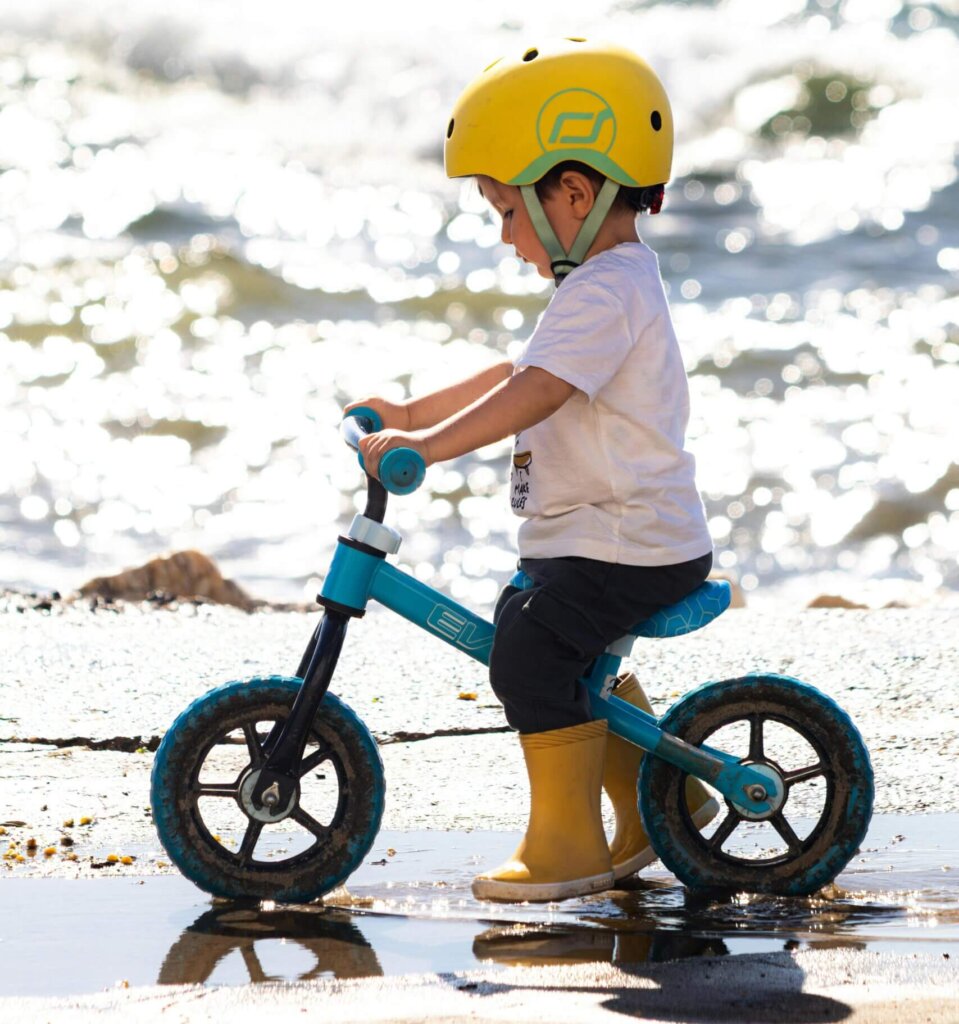
Before a child worries about pedaling, they need to understand balance. Removing the pedals turns any standard bike into a balance bike. The child scoots and glides, learning to feel the two-wheel experience without the added cognitive load of pedaling. Balance bikes encourage the disassociation of two legs in a pedaling motion and are helpful for teaching bike riding from age two and older.
Address the sensory piece
For children who process sensory input differently, the vestibular experience of riding a bike — leaning, turning, shifting weight on a moving object — can feel genuinely threatening. An OT can help a child build tolerance for that input gradually, so it stops triggering a stress response before learning can happen.
Break motor planning into steps
There are many components required for bike riding, including motor planning, body awareness, trunk control, balance, self-confidence, following directions, safety awareness, timing, and sequencing. OTs break this sequence into component parts and practice each one before combining them. They are also trained to praise small wins — buckling a helmet independently, putting down the kickstand — because confidence builds skill.
Build frustration tolerance deliberately
Learning to ride a bike involves falling. For children who struggle with frustration tolerance, that experience can shut everything down before progress happens. OTs understand how to support a child through that window — holding the space without rescuing them from the discomfort, which is where the real learning happens.
A clinical study of 53 children who participated in a therapeutic bike riding program found that 89% learned to ride independently, with the majority learning within four hours. The intervention was structured, sequential, and therapist-led. The results reflect what happens when the right support is applied.
What Physical Therapists Bring to Bike Riding
While OTs focus on the functional and sensory side, physical therapists focus on the mechanical: strength, range of motion, coordination, and postural control.
For bike riding specifically, a PT may address:
Core strength and stability. A child who cannot hold their trunk upright cannot balance on a moving bike. Regular use of balance bikes helps improve core strength, stability, and spatial awareness. PTs often address core stability as a prerequisite, not an afterthought.
Low muscle tone. Children with hypotonia may find pedaling more effortful than expected. A PT can identify whether muscle tone is contributing to the difficulty and address it directly.
Bilateral coordination. Riding a bike requires the left and right sides of the body to work in coordination — legs pedaling while arms steer. For children with asymmetry or coordination challenges, this is a specific area of intervention.
Proprioception and body awareness. Proprioception is the sense of where your body is in space. Children with proprioceptive differences often struggle with the spatial demands of bike riding — knowing how far to lean, when to turn, and how to stay upright. PTs can work on this systematically.
Balance and postural control. Children with hypermobility, vestibular differences, or motor delays may have underlying postural challenges that make two-wheel balance harder than it appears. A PT can assess and treat this directly.
OT and PT often overlap in bike riding work. For children with more complex needs, both perspectives together can be the most effective approach.
The In-Home Advantage
This is where Coral Care’s model matters in ways that go beyond convenience.
Jen’s daughter learned to ride in their backyard, on their street, and in a nearby parking lot. Not in a clinic. Not in a gym. In the actual environment where she would eventually ride on her own.
This matters clinically. Motor skills transfer best when they are learned in the environment where they will be used. A child who learns to balance in a sterile clinical hallway still has to transfer that skill to a real driveway, a real sidewalk, with real terrain variation and real distractions. That transfer takes extra time and often extra repetition.
When therapy happens at home and in the neighborhood, there is no transfer gap. The skill is built exactly where it will be practiced. The parents are present and learn the cueing strategies alongside the child. The environment itself becomes part of the intervention.
One OT described working with children on bikes outdoors: “It doesn’t really matter the condition of the lawn or yard. Kids can ride in small spaces. We can get them out on a deck or even do it in an apartment. The kids have so much fun, and their caregivers are very proud.”
That is what in-home therapy looks like when it is working.
Some Kids and Parents Need Extra Help. That’s Not a Failure.
There is a version of this story that a lot of parents carry quietly. You tried to teach your child to ride a bike. It didn’t go well. Maybe there were tears — yours or theirs or both. Maybe you blamed the bike, or the weather, or the fact that you never had patience for this kind of thing.
Jen has talked openly about this. She tried the standard approach, and it didn’t work. Her daughter needed a different approach and had a harder time with it than most kids. Getting her OT involved was not a concession. It was the right call.
For children with ADHD, autism, sensory processing differences, dyspraxia, low muscle tone, anxiety, or any condition that affects motor learning or frustration tolerance, bike riding is not always a skill that unfolds naturally with practice and encouragement. Sometimes it needs professional support, a structured progression, and a clinician who understands how to meet a child where they are.
If you have been trying and not making progress, that is useful information. It is not a reflection of your parenting or your child’s potential. It is a signal that a different approach is needed.
How to Choose the Right Bike
Bike fit is underrated as a factor in learning to ride. A bike that is too large or too heavy creates additional barriers that have nothing to do with the child’s ability.
It is important to buy a bike that fits well now rather than one that is too large to “grow into.” When a bike fits right, it is easier for kids to handle, safer, and more enjoyable to ride.
Kids’ bike sizes are best determined by wheel size, which directly correlates to frame size. Age can provide a rough estimate, but height is a more accurate guide. Here is a general reference:
- 12-inch wheels: Under 4 years old, roughly under 38 inches tall
- 16-inch wheels: Ages 3 to 7, roughly 38 to 48 inches tall
The most accurate way to size a bike is by measuring your child’s inseam rather than relying on age or height alone.
When your child sits on the seat, for beginners, their feet should be flat on the ground. For riders who already have balance confidence, only the toes need to touch.
A few additional things to check: knees should not hit the handlebars at full pedal extension, the child should be able to easily straddle the top tube with feet flat, and the bike should be light enough for the child to lift and maneuver independently.
For children with motor or sensory differences, also consider hand brakes versus coaster brakes (hand brakes require more coordination), tire width (wider tires offer more stability), and overall bike weight (heavier bikes are harder to control for kids with lower muscle tone).
When to Ask for Help
If your child is past the typical learning window, has been trying without progress, or is showing significant distress around the activity, it is worth talking to a pediatric OT or PT. This is especially true for children with:
- Sensory processing differences
- ADHD or difficulty with sustained attention
- Low muscle tone or hypermobility
- Autism spectrum disorder
- Dyspraxia or developmental coordination disorder
- Significant anxiety around motor challenges
- Any diagnosis that affects balance, coordination, or motor learning
Bike riding is within scope for both OT and PT. It is not a peripheral skill — it is functional, it is social, and it builds real developmental assets: balance, coordination, core strength, motor planning, and frustration tolerance. You do not need to wait until everything else is addressed. Bike riding can be the intervention.
ABOUT THE AUTHOR
Jen Wirt is the founder and CEO of Coral Care, a platform helping families access high-quality pediatric therapy—without the waitlists, confusing systems, or insurance hurdles that too often stand in the way. Coral Care connects families with trusted speech, occupational, and physical therapists for in-home sessions and supports clinicians in building sustainable private practices.
RELATED ARTICLES
- First Year Developmental Milestones and Physical Development
- How to Plan a Fun and Safe Playdate for Toddlers
- Simple, Screen‑Free Spring Activities That Help Young Children Learn and Grow
Cover image by Emrican Dora