When does periomenopause actually begin?
When evaluating women who come to see me for hormone optimization, a discussion of symptoms is very important.
On the first consultation I also discuss the extensive panel of hormones that they had drawn a few weeks before meeting with me. Perimenopausal hormones can be quite subtle. The brain FSH hormone starts to climb a bit from its ideal 2-5 level, and even an FSH of 6, accompanied by a lower estradiol level and significant symptoms, can indicate early perimenopause and early signs that fertility can be starting to wane a bit.
Women can be quite upset when they hear that they are perimenopausal at a much younger age than expected, especially if they desire children. I quickly reassure these women that perimenopause is actually a pretty fertile time, but that it’s a good idea to become more definite about whether they desire children or not, and to create a fertility plan. If partners have differing opinions, counseling can help. Repeating the FSH on day 2 of a few cycles is helpful to identify fertility, as is an ‘Anti Mullerian Hormone.’ This AMH is around 80% accurate in predicting poor ovarian response or premature ovarian failure. I also suggest seeing a fertility doctor to discuss their fertility and pregnancy plans and perhaps elect to freeze their eggs. For many of my patients who need to wait until much later to conceive, they have successful pregnancies in their 40’ss or early 50s.
In fertility clinics, pregnancy after the age of 40 tends to decrease a bit, but MANY women conceive and carry pregnancies successfully.
If women aged 40-45 try to conceive naturally, 20 – 30 % will conceive within a year. I have happily delivered women aged 48-49 who spontaneously conceived and had successful outcomes; twins in 3 different cases. Knowing if you want children or not, really helps prioritize the outcomes. I personally wanted children very much and made it a priority goal, becoming pregnant as soon as my OB-GYN residency was finished. My third child was born a few months before my 41st birthday.
I am frequently asked how to extend and preserve ovarian function.
1. A healthy non-inflammatory diet is very helpful. eliminating gluten and frequently dairy, sugar, and refined carbohydrates. Eating lots of greens and plants that are rich in polyphenols is also excellent, as are organic, pasture-raised eggs and meat, and only wild fish, not farmed fish.
2. Decrease exposure to pesticides.
3. Sleep 8 or more hours each night.
4. Healthy exercise like HIIT training, weights, yoga, and walking.
5. Acupuncture and other integrated therapies can be very helpful.
6. Reduce your stress and add meditative, relaxed times into your days.
7. Supplements that support the Mitochondria (the cell’s power house) are excellent: COQ10 200 mg daily, PQQ 20 mg daily, pure omega-3, curcumin 100-2000 mg daily, and pure shilajit, which is an Indian ayurveda remedy. Pregnancy Prep by Vitanica is one of my go-to supplements to help women normalize their cycles and achieve pregnancy. I have been surprised by the number of women who rapidly conceive after a few months of use.
8. Balance your hormones to youthful levels for youthful results. I check 20 different hormones and especially optimize the Adrenal Stress hormones with DHEA (10-20 mg daily is average if depleted, pregnenolone 30-50 mg daily, depending on the severity of the depletion. I am especially concerned about thyroid optimization, as 40 % of the time, thyroid deficiencies are not diagnosed with normal blood work. This can cause increased miscarriages and more infertility. Checking a woman’s ovarian hormones is also critical. I always check the hemoglobin A1C, which measures sugar damage to the cells over the last 4 months. Higher levels of sugar damage causes aging of organs, as well as the ovaries. Refined carbohydrates, stress, low estradiol, and lack of exercise l can all increase the A1C.
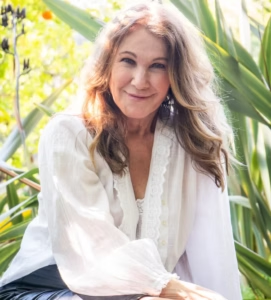 ABOUT THE AUTHOR
Prudence Hall, M.D., is a physician with a vision. A traditionally-trained gynecologist and surgeon turned pioneer in integrative and regenerative medicine, Dr. Hall envisions a future where “average” and “normal” are no longer acceptable standards of health. Helping her clients achieve unbridled radiance, vitality, joy and sensuality, and not just an absence of disease, she addresses all aspects of health: the physical body, thoughts and emotions, connection to the authentic self, and a life of fulfillment. She is an outspoken advocate for natural solutions instead of synthetic hormones, prescription medications and the like.Dr. Hall is one of the nation’s leading experts on menopause and has a passion for helping women not only navigate its challenges but to thrive in the process. Her book, Radiant Again and Forever, chronicles some of these real, relatable patient journeys. In private practice for more than 35 years, she has treated over 40,000 patients.
RELATED ARTICLES
- 5 Ways To Make Fertility Treatment More Affordable ― Without A Job
- Male Factor Infertility – A Contributing Factor in 50% of Cases
Cover photo by Sarah Chai