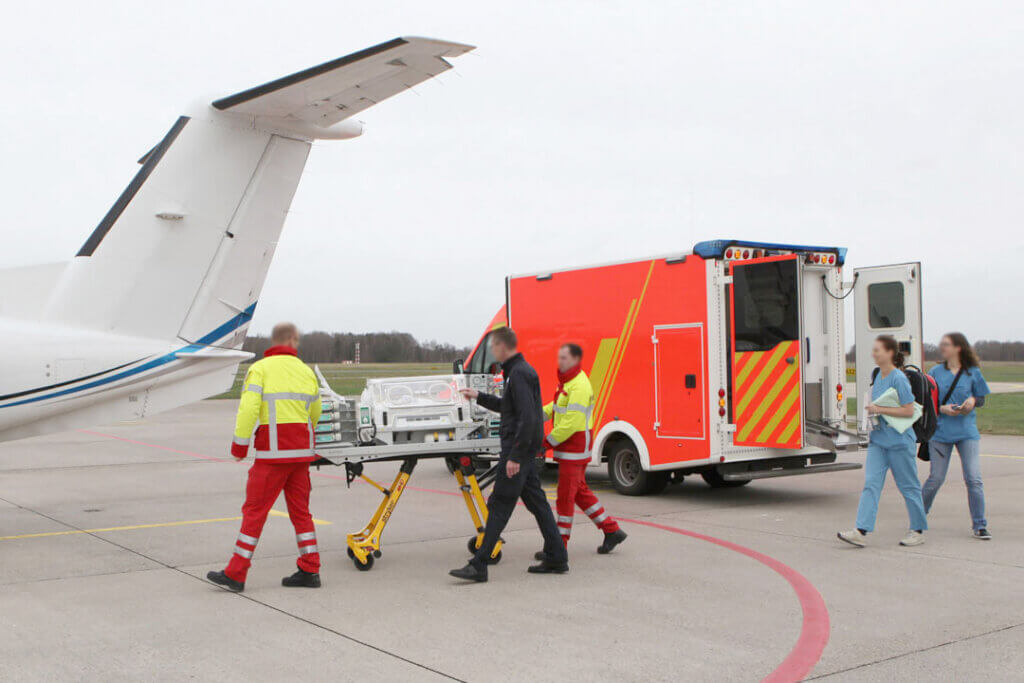
Few things are more overwhelming for parents than learning that their newborn requires specialist treatment at another hospital. In one moment, they celebrate their new arrival. In another, they talk to neonatologists, hear medical jargon, and try to understand why their child needs to be transferred elsewhere.
Many parents also discover that a neonatal medical air ambulance exists for the very first time. They have numerous questions regarding this procedure as well as its safety and purpose. Even though they will hardly be able to relax in this situation, understanding it is important for reassurance. The following are common questions that parents ask before a neonatal medical air ambulance transfer.
Why does my baby need a neonatal medical air ambulance?
Many parents are confused as to why their baby should not stay where he or she was born.
As a matter of fact, some newborns need specialist treatment that can be provided only at hospitals equipped with advanced neonatal intensive care units (NICUs) or specialist pediatric centers. Those include premature infants, babies with congenital heart defects, neurological issues, respiratory complications, and those that require immediate surgery after birth.
All these decisions are carefully assessed by neonatologists to determine whether another hospital can provide a better outcome for their patient. Thus, the transfer itself becomes an integral part of treatment in these cases as the aim is to provide specialized care in the form of transport.
Is it really safe for such a small baby to fly?
This question is probably the first one that comes into parents’ minds.
It is difficult to imagine how a tiny, fragile newborn can board an aircraft, especially since he is just a few pounds heavy or even requires some intensive care. However, that is exactly what neonatal air ambulance transfer is designed for.
Before the flight can take place, the medical team performs a thorough examination of the newborn’s health status. He is evaluated for breathing, heart condition, oxygen requirements, body temperature, medications, and weight. After this, all the aspects of the transport are organized in accordance with these parameters.
The aircraft itself acts as a flying neonatal intensive care unit. Throughout the journey, specialists will continuously monitor the baby’s health and can make necessary adjustments immediately. The idea is to provide continuous intensive care during the transfer, from leaving the first hospital to being received at the second.
What happens during the flight?
Many parents are surprised by what a neonatal air ambulance looks like. At the center of the cabin there is a transport incubator, which creates a carefully controlled environment for the baby. In case of premature infants, in particular, regulation of body temperature is impaired, and they are extremely sensitive to any changes in the environment. Thus, the incubator ensures that the baby’s body temperature is regulated throughout the whole trip.
Around the incubator, there is equipment that is similar to that in a neonatal intensive care unit. Depending on the baby’s needs, it includes neonatal ventilators, cardiac monitors, infusion pumps, oxygen supplies, suction equipment, and emergency medications. All the equipment is safely placed in the aircraft and operates independently on electricity in order to provide uninterrupted work during the transfer.
Apart from that, there are highly qualified neonatal specialists on board the airplane. Depending on the condition, the team can consist of a neonatologist, neonatal intensive care nurses, respiratory therapists, or pediatric critical care specialists who are skilled not only in providing care for newborns but also in doing so during air transport.
Throughout the flight, the medical team continuously monitors the baby’s heart rate, oxygen levels, breathing, blood pressure and general condition. All the changes needed are made in terms of medications, ventilation and other treatment measures.
For the baby, the trip is yet another stage of intensive care.
Can I travel with my baby?
Providers like Medical Air Service have the legal obligation to accommodate at least one parent on board the airplane.
If the other parent cannot travel in the aircraft, it doesn’t mean that he or she is completely excluded from the process. The air service provider maintains contact with the medical team while updating the parent about the situation if it is required. Moreover, providers are always willing to arrange transportation separately so parents can reach the receiving hospital as soon as possible.
Even though the parents want to be close to their baby, every decision is made with only one objective in mind – providing the safest environment for the patient.
How is everything organized before the flight?
Families are often surprised by the number of preparations that happen before the aircraft even takes off.
A neonatal transfer implies coordination between the referring hospital, the receiving hospital, flight coordinators, and the medical team. All the medical data – medical records, images, laboratory results, and the treatment plan – is provided to the receiving specialists in order to give them a full understanding of the patient’s condition.
At the same time, the flight coordinators arrange the aircraft, the special medical equipment, airport operations, and ground ambulances as well as international permits, if necessary. All these processes occur simultaneously to prepare all aspects of the mission.
The process can be described as a “bed-to-bed” transfer, as medical care continues continuously from one hospital bed to another. Instead of organizing just transportation, the whole mission is prepared with the aim of continuing medical care throughout the process.
What happens after we land?
Landing is not the end of the transfer. It is simply one of the final stages of the whole journey.
Before landing, the ground ambulance is waiting at the airport with the receiving hospital ready for the patient’s arrival. The neonatal medical team continues to take responsibility for the patient during the transfer from the aircraft to the ambulance and during the trip to the hospital.
Since the receiving neonatal intensive care unit has already analyzed the patient’s medical information and discussed the treatment plan with the referring team, the admission to the unit starts immediately.
For the parents, it is reassuring to know that everything is already done before their baby even lands.
Every transfer is centered on one goal
For the parents, hearing that their newborn requires neonatal medical air ambulance is a very stressful experience.
Questions they ask reflect the same concerns that any parent could have: Is my baby safe? Who will take care of him? What is happening during the journey? Is everything ready for us? Behind every neonatal transfer lies an enormous amount of work by many people, including doctors, neonatal specialists, flight coordinators, and receiving hospitals.
From the very beginning, every decision is made with the aim of maintaining continuous medical care throughout the whole journey.
Ultimately, a neonatal medical air ambulance is more than the mere transportation of the patient. It is a flying neonatal intensive care unit that gives the baby an opportunity to receive the specialist treatment he or she needs.
ABOUT MEDICAL AIR SERVICE
Adam Mikulski is the General Director at Medical Air Service. Medical Air Service provides worldwide medical evacuation, medical repatriation, and medical escort services, transporting patients who cannot be treated where they are and transferring them to the required destinations on board fast medical jets or with medical escorts on commercial flights.
RELATED ARTICLES
- Safety & Comfort for Medically Fragile Babies
- Infant Car Seat Safety Guide for Parents
- Babyproofing Beyond the Basics: Hidden Risks Every New Parent Should Know
Cover Image provided by Medical Air Service