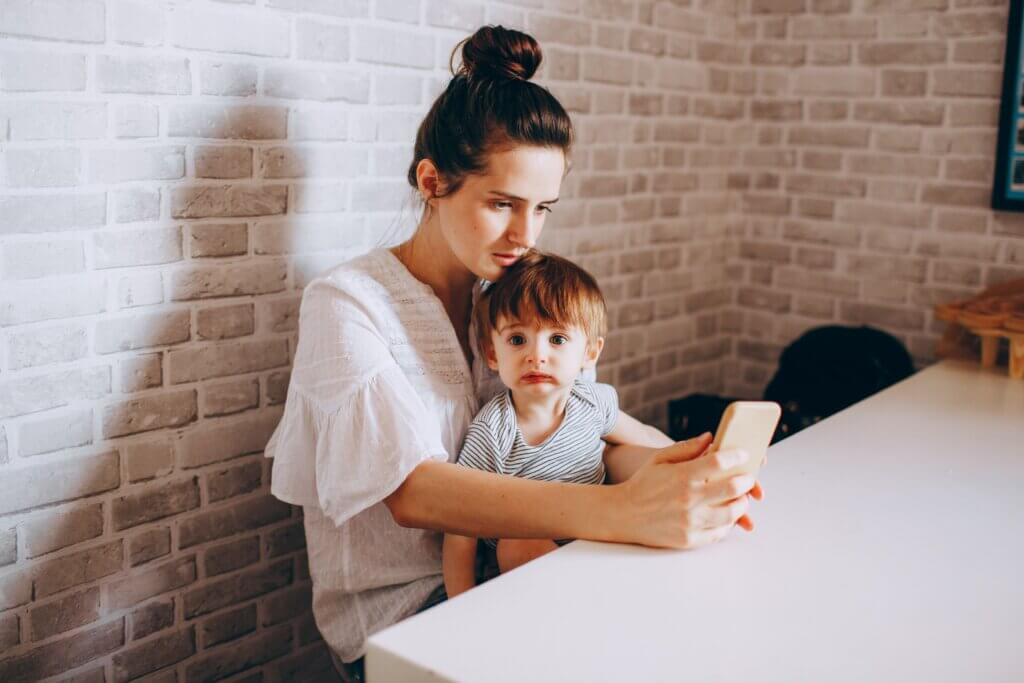
The momfluencer culture fuels comparison, perfectionism, and maternal guilt. It is possible that motherhood can begin to feel like a performance.
You close the app and immediately wonder if you’re doing enough. Should you be making homemade baby food? Breastfeeding longer? Reading more books? Sleep training? Playing more intentionally? Enjoying every moment?
For many mothers, these thoughts have become a familiar soundtrack to everyday life. Social media has transformed how parents connect, learn, and share their experiences. It has created communities that reduce isolation, normalize difficult conversations, and remind mothers they are not alone. Yet alongside these benefits, it has also created an environment where comparison is constant, and perfection feels increasingly attainable.
The challenge isn’t simply that mothers compare themselves to others. It’s that these comparisons are happening during one of the most profound neurological and psychological transitions a woman will ever experience. Researchers describe this transition as matrescence, the developmental process of becoming a mother. Much like adolescence, matrescence involves dramatic shifts in identity, relationships, priorities, and even the structure and function of the brain. Understanding this transformation helps explain why curated images of motherhood can feel so deeply personal and why so many women leave social media questioning whether they are doing enough. (Orchard, E. R., Rutherford, H. J. V., Holmes, A. J., & Jamadar, S. D. 2023)
Why Comparison Feels So Powerful
Motherhood changes the brain in remarkable ways. Emerging neuroscience has demonstrated that pregnancy and the postpartum period are associated with changes in brain regions involved in empathy, emotional processing, caregiving, and social awareness. These adaptations help mothers become more responsive to their babies’ needs and strengthen the parent-child bond. (Servin-Barthet, C., Martínez-García, M., Pretus, C., Paternina-Die, M., Soler, A., Khymenets, O., Pozo, Ó. J., Leuner, B., Vilarroya, O., & Carmona, S. 2023). Far from being a weakness, this heightened sensitivity is an extraordinary biological adaptation designed to help mothers nurture and protect their children.
At the same time, however, that increased sensitivity can make mothers more aware of social cues, uncertainty, and perceived judgment.
When a woman is already asking herself, Am I doing this right?, social media provides an endless stream of opportunities to look for the answer in someone else’s life.
This isn’t vanity. It’s often the maternal brain searching for reassurance during a season of enormous change.
Psychologists have long recognized that humans naturally compare themselves to others to evaluate their own experiences (Kretz, V. E., 2020). But today’s mothers are no longer comparing themselves to a handful of neighbors or close friends. Instead, they are comparing themselves to hundreds of carefully curated snapshots of motherhood every week. Over time, those images begin to shape expectations of what “good motherhood” is supposed to look like.
The Illusion of Perfect Motherhood
Momfluencer culture rarely tells the whole story. We see beautiful nurseries but not the sleepless nights. Or, smiling family photos but not the tears before the picture was taken. There are organized playrooms, homemade meals, peaceful bedtime routines, and babies who appear content around the clock. What we don’t often see are the moments that define real motherhood: identity shifts, relationship changes, overwhelming mental load, loneliness, uncertainty, or the exhaustion that comes with caring for a completely dependent human being.
Even the most authentic creators are still sharing carefully selected moments. Social media algorithms naturally reward content that is visually appealing, aspirational, and emotionally engaging. As a result, mothers can begin to mistake a collection of highlight reels for the everyday reality of parenting.
That comparison often starts with love.
Most mothers aren’t trying to compete with one another. They simply want to give their children the very best, but that desire can quietly evolve into self-doubt.
Maybe I should be doing more. Maybe everyone else enjoys motherhood more than I do. Maybe I’m the only one struggling.
Those thoughts don’t stay on a screen. They often become internal narratives that shape how mothers view themselves.
Research has consistently linked perfectionistic concerns, particularly excessive self-criticism and fear of making mistakes, with higher levels of maternal anxiety and depression during the perinatal period (Evans, C., Kreppner, J., & Lawrence, P. J., 2022). When mothers begin believing they must excel in every aspect of parenting, every difficult day feels like evidence that they are somehow failing. The reality is quite different. Struggle has never been evidence of poor parenting. It is evidence that motherhood is one of life’s most demanding developmental transitions.
The Missing Conversation: Sleep and Mental Health
One of the most overlooked pieces of this conversation is sleep. Sleep deprivation has become so normalized in early motherhood that many women view exhaustion as something they simply have to endure. In reality, sleep plays a vital role in emotional regulation, decision-making, attention, and resilience. When mothers are operating on fragmented sleep, the brain becomes more vulnerable to anxiety, negative thinking, emotional reactivity, and self-criticism. (Servin-Barthet, C., et. al, 2023).
The same social media post that feels inspiring after adequate rest may feel deeply discouraging after weeks of interrupted sleep. This is one reason why postpartum support should extend far beyond conversations about diapers, feeding schedules, and developmental milestones. Supporting maternal mental health also means supporting the mother’s basic biological needs, including sleep, recovery, education, and connection.
When these needs go unmet, comparison often becomes louder—not because mothers are weak, but because exhausted brains process the world differently.
Choosing Connection Over Comparison
The answer isn’t abandoning social media. For many women, online communities provide encouragement, education, and friendships that might otherwise be unavailable during the isolating months of early parenthood. The goal is not to consume less information, but to consume healthier information.
Ask yourself:
- Does this account leave me feeling informed, or inadequate?
- Does it encourage curiosity, or perfection?
- Does it remind me that every family’s journey is different?
The healthiest online communities don’t suggest there is only one right way to parent. Instead, they make room for changing feeding plans, messy homes, difficult emotions, interrupted sleep, and imperfect days. They remind mothers that flexibility is not failure. Most importantly, they remind women that motherhood is not a performance.
Redefining What It Means to Be a “Good Mom”
Perhaps the greatest gift we can offer new mothers is permission to stop measuring themselves against an edited version of someone else’s life. Children do not need perfect mothers. They need mothers who are supported. Mothers who have access to evidence-based information instead of unrealistic expectations. Mothers who understand that asking for help reflects strength, not inadequacy.
Momfluencer culture did not create maternal guilt, but it has amplified it by placing impossible standards within reach every hour of every day. The antidote isn’t perfection; it’s perspective.
When mothers understand that their brains are adapting, that comparison is a natural but often misleading response during matrescence, and that no social media feed captures the full complexity of parenting, they can begin replacing self-judgment with self-compassion.
Because motherhood was never meant to be performed. It was meant to be lived. Social media can be a wonderful source of inspiration, but it should never become the blueprint by which you measure your worth as a mother. Your story, your baby, and your journey were never meant to look exactly like anyone else’s.
References:
- Evans, C., Kreppner, J., & Lawrence, P. J. (2022). The association between maternal perinatal mental health and perfectionism: A systematic review and meta-analysis. British Journal of Clinical Psychology, 61(4), 1052-1074.
- Kretz, V. E. (2020). Social Comparison Theory. In The International Encyclopedia of Media Psychology. https://doi.org/10.1002/9781119011071.iemp0156
- Orchard, E. R., Rutherford, H. J. V., Holmes, A. J., & Jamadar, S. D. (2023). Matrescence: Lifetime impact of motherhood on cognition and the brain. Trends in Cognitive Sciences, 27(3), 302–316.
- Servin-Barthet, C., Martínez-García, M., Pretus, C., Paternina-Die, M., Soler, A., Khymenets, O., Pozo, Ó. J., Leuner, B., Vilarroya, O., & Carmona, S. (2023). The transition to motherhood: Linking hormones, brain and behaviour. Nature Reviews Neuroscience, 24(10), 605–619.
ABOUT THE AUTHOR
Dr. Nicole Kumi, PhD, PMH-C, is the founder of The Whole Mom, an organization dedicated to transforming maternal mental health through prevention, education, and community. She developed the evidence-based Fourth Trimester Program to help mothers navigate the transition into parenthood with practical tools, connection, and science-backed support. Dr. Kumi is the author of Born Together and a national speaker on postpartum mental health, sleep deprivation, and the neuroscience of motherhood. Her work has been featured by FOX 5 DC, The Guardian, The Bump, and Chalkboard Magazine
RELATED ARTICLES
- I Love My Baby, But Where Did I Go? The Science of Finding Yourself Again After Motherhood
- Unique Daily Habits to Boost Mental Wellness for First-Time Parents
- 5 Positive Psychology Tools That Actually Help Postpartum Overwhelm
- The Guilt I See in Parents at The Dentist’s Office And What I Wish They Knew
Cover image by Helena Lopez