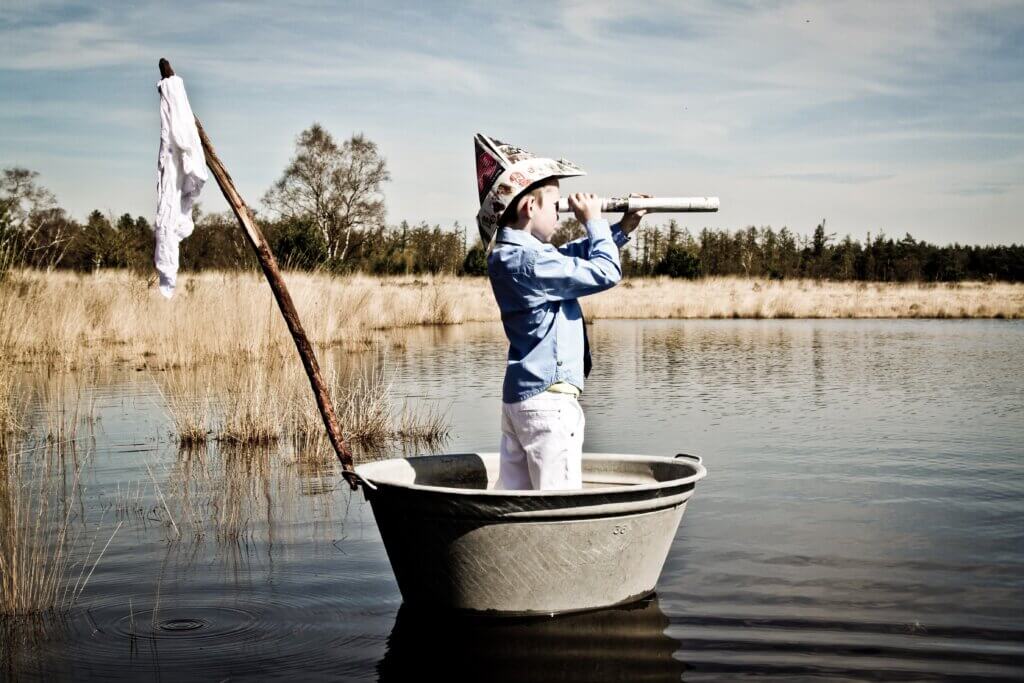
Overview: Giving children the freedom to lead their own adventures fosters independence, builds confidence, and encourages natural curiosity. By stepping back and letting kids take the reins, parents can support deeper learning, resilience, and problem-solving skills through child-led play and exploration.
Why the best thing you can do for your child’s development might be to stop being in charge of the game.
Activities may be guided, but real adventures are an experience of total freedom. Freedom can be scary. Even dangerous. And it is also liberating. Freedom is not something we earn. It is not a luxury or a privilege — it is the very essence of who we are. We are born free, with open hearts, curious minds, and an endless capacity to imagine. But somewhere along the way, the walls start to close in. Rules pile up. Expectations weigh us down. We learn to color inside the lines and keep our voices at a “polite” volume. And the wild, joyful freedom that once felt so natural… begins to fade into the background.
When we hear about oppression, or about people whose choices are far fewer than our own, we feel shocked. Yet so often, we forget to notice how even in our “free” lives, we are quietly limiting ourselves — and each other. We don’t always see the invisible cages we’ve built around children, students, and even our own dreams.
True freedom is happiness. When we are limited, we suffer. When we are free, we expand into joy. This is why yoga’s highest goal is Moksha — liberation — and why the Buddhists speak of Nirvana. But freedom is not just a spiritual concept; it is a lived experience, and one that children understand far more instinctively than most adults.
I remember a little girl named Daniela in a preschool where I taught for several years. She was, secretly, my favorite student. Daniela always sat close to me, and yet… she never once followed my instructions exactly.
If I asked everyone to do a pose, she would invent her own on the spot. And so often, her new creation was so brilliant that I added it to my own yoga repertoire.
The other children never complained or tried to “correct” her. They recognized she had a special role in their little society — the role of the creator, the one who sees a new way.
But not every adult saw it that way. Sometimes the preschool teacher would scold Daniela for not following the plan, and she would shrink into tears. Those moments always made me wonder — are we here to train obedience, or to nurture originality?
Is our job as teachers to control, or to set minds and bodies free?
As adults, we like to believe we live in freedom. We make choices every day, and yet, we still confine ourselves and the next generation within invisible boundaries. Our education systems, our workplaces, and even many yoga classes reward following instructions far more than independent thought or bursts of creativity.
And yet, the people who change the world — the artists, inventors, leaders, and visionaries — are rarely the ones who simply obeyed. They were the rebels, the misfits, the “rule breakers,” the ones willing to look a little foolish in order to be true to themselves. Every child is born with that same spark — the question is, will we protect it or smother it?
We seem to openly expect, encourage, and appreciate obedience in children. Yet none of us would agree to be an obedient adult, or want our children to become one.
As a kids’ and family yoga teacher, I feel a deep responsibility to rebel against any system that would dim that light. Of course, a quiet, compliant classroom might be easier for adults to manage. But what good is easy if it comes at the cost of curiosity, imagination, and joy?
The true purpose of education — and of yoga — is not to create people who will simply maintain the world as it is. It is to raise free, fertile minds and open, fearless hearts that can help our civilization grow into something better. It is to give the next generation the tools to live a good, happy life — a life of freedom — and to use that freedom to make the world a kinder, more vibrant place.
Why Letting Go of Control Boosts Child Development
What if we let go of control?
What if we loosen our grip on control?
What if we stop demanding that every movement look the same, and instead create spaces where creativity is celebrated?
What if we stop expecting children to follow our instructions in play, and instead let them follow their own hearts and let their sparks of imagination grow into bright flames of laughter and connection?
What if we let go of our egos, step back from the role of commander, and take up the role of a catalyst?
Times are changing quickly, and so is the way we need to relate to young people. There are a few elements to becoming someone who can inspire and influence young people now… The days of “because I said so” are over: young people don’t see us adults as big authorities anymore, and they have access to knowledge and fact-checking at their fingertips. The sentence “because I said so” would be unacceptable to hear as an adult in most circumstances, perhaps aside from being a soldier… And oh, the world has too many soldiers and too many wars.
The way to young minds is first to treat them as equals. Children are often treated as second-class citizens in our society; this immediately creates a disconnect between teachers/parents and young people. We must treat them with the same respect we expect to receive from them. We need to value their opinions and accept their ways of being and doing. We need to listen to them at least as much as we want them to listen to us.
Understanding Your Child’s Perspective on Freedom and Autonomy
We all know that it is not easy to be a grown-up, and especially it is not easy to be a parent, but have you ever thought about how challenging it is to be a kid? Imagine every action of yours being scrutinized, always being told what to do and what not to do, needing to ask permission for everything, being rushed to stop playing and get into the car or to bed. Maybe you can’t even reach the light switch!
Living in the same way as a grown-up would be some kind of very exotic torture. So how can we ease the suffering of these poor children? Of course, I’m (only half) joking.
There are also great things about being a kid! People shop and cook for you, drive you around, read you stories, buy you toys — not much to worry about! But kids do worry. And kids do crave freedom. And if they are not lovingly held while they explore their freedom, they take it by force.
Let the child’s opinion matter to you. Open things for discussion, and be ready to possibly accept what they are saying or reach a compromise.
In our free time, we grown-ups will choose to do things that are of interest to us, things that give us pleasure. Yet, more often than not, especially in the mainstream education system, we force the direction of the learning or the activities.
The Power of Interest-Based Learning and Child-Led Play
Interest-based learning can be much more effective than learning that is forced. After all, when we learn about anything, it helps us learn about everything. And I think that, with children, most of all we should aim to inspire our children to love learning.
Trust in the children’s wisdom to make worthwhile choices about what they want to engage with. And of course, be by their side to guide and empower them along the way.
A new concept in education that is very valuable is CONNECT before CONTENT. We can’t just show up to play and dump instructions or information on the children and expect them to retain it or make it a part of their lives. They are overloaded with information already. To make an impact, to inspire, we must first take the time to connect with those young souls.
I am inviting you to join me in this rebellion — to bring more freedom into our classes, our homes, and our communities. The world doesn’t need more people who follow the script. It needs people who will write new stories. Let’s set the stage for them to do exactly that.
ABOUT THE AUTHOR
Gopala Amir Yaffa is the Founder, Co-Director & Owner of Rainbow Yoga. Gopala has been practicing yoga and meditation since he was 14 years old. He was a Hindu monk for 10 years with the Sivananda Ashrams. He has been teaching yoga since 1995. With Rainbow Yoga, Gopala made the practice social and interactive. Love, community, and connection are at the heart of Gopala’s intentions to change the world one person at a time. Learn more at: https://www.
Cover Photo by Fritz Jaspers